CO₂ Laser vs. Scalpel Surgery for Gingival Hyperplasia: What a 2023 Clinical Trial Reveals
- Raymond G. Lee

- Dec 6, 2025
- 2 min read
Hello everyone, this is Raymond Lee from Raymond’s Dental Solutions.Today, I’m excited to share a 2023 study from the Journal of Periodontology titled “Efficacy of CO₂ Laser in the Treatment of Gingival Hyperplasia: A Randomized Controlled Trial.”
This research directly compared CO₂ laser surgery with traditional scalpel excision for gingival hyperplasia and provides strong clinical evidence that every modern soft-tissue dentist should know.
🎯 Study Purpose
The goal of this trial was to determine which technique — CO₂ laser ablation or conventional scalpel surgery — delivers better clinical outcomes, faster healing, improved patient comfort, and lower recurrence.

👥 Study Design & Methodology
This parallel-group randomized controlled trial included 60 patients diagnosed with moderate to severe gingival hyperplasia.
Participants were randomly assigned to two equal groups:
1️⃣ CO₂ Laser Group
Super-pulsed CO₂ laser
4-watt defocused beam
1–2 mm spot size
2️⃣ Scalpel Surgery Group
Traditional scalpel excision
Electrocautery for bleeding control
All procedures were performed under local anesthesia, and the tissue was removed down to the alveolar crest.Outcomes were evaluated on Days 0, 1, 3, 7, 14, and 30, using:
Pain (VAS 0–10)
Healing index (Landry scale)
Bleeding (intra- & postoperative)
Patient satisfaction (Likert scale)
Recurrence at 6 months
📊 Key Findings
The results were striking and strongly favored the CO₂ laser.Here are the core takeaways highlighted in the study:
Significantly less intraoperative bleeding in the laser group
Lower postoperative pain scores compared to scalpel surgery
Faster wound healing as reflected in Landry healing index
Higher patient satisfaction, particularly regarding comfort and recovery
Similar recurrence rates between both groups at 6 months
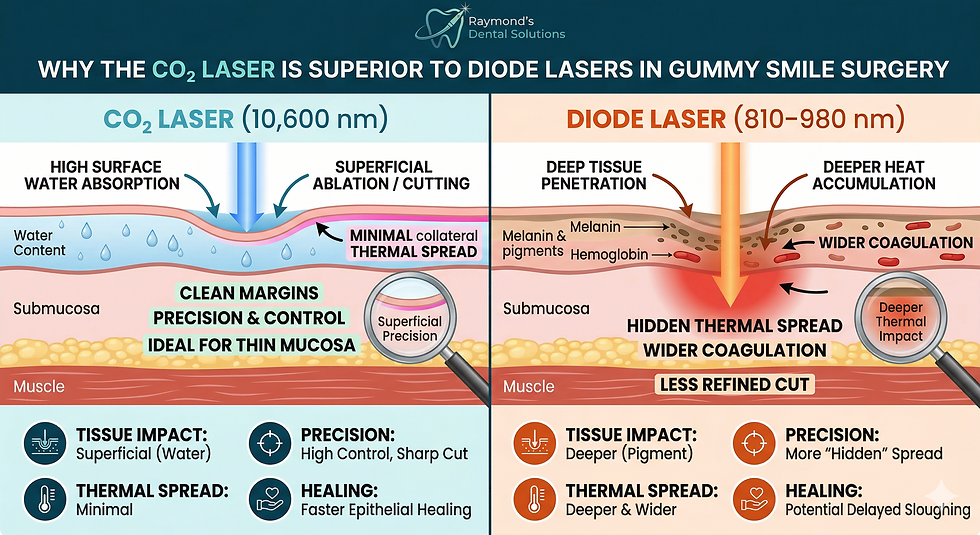
Histological evaluation also showed that CO₂ laser incisions produced a very thin coagulation zone (<100 nanometers) with no carbonization or tissue charring, which contributes to superior healing.
No sutures were needed, and zero adverse events occurred in the laser group — a major clinical advantage.
🏁 Conclusion
The authors conclude that CO₂ laser surgery is a more effective, predictable, and patient-friendly treatment option for gingival hyperplasia than traditional scalpel excision.
Benefits include:
✔ Minimal bleeding
✔ Reduced postoperative discomfort
✔ Accelerated wound healing
✔ Greater patient satisfaction
✔ Equivalent recurrence control


.png)

Comments