Why the CO₂ Laser is Especially Superior to Diode Lasers in Gummy Smile Surgery

Hello everyone, this is Raymond from Raymond’s Dental Solutions.
When treating a gummy smile with lip repositioning surgery, many clinicians find themselves asking one fundamental question: "Is a diode laser really enough — or is a CO₂ laser fundamentally better for this procedure?"
The answer actually comes down to a very important concept: tissue physics. Today, let’s take a closer look at the scientific reasons why CO₂ lasers often perform better than diode lasers for lip repositioning surgery used to treat a gummy smile.
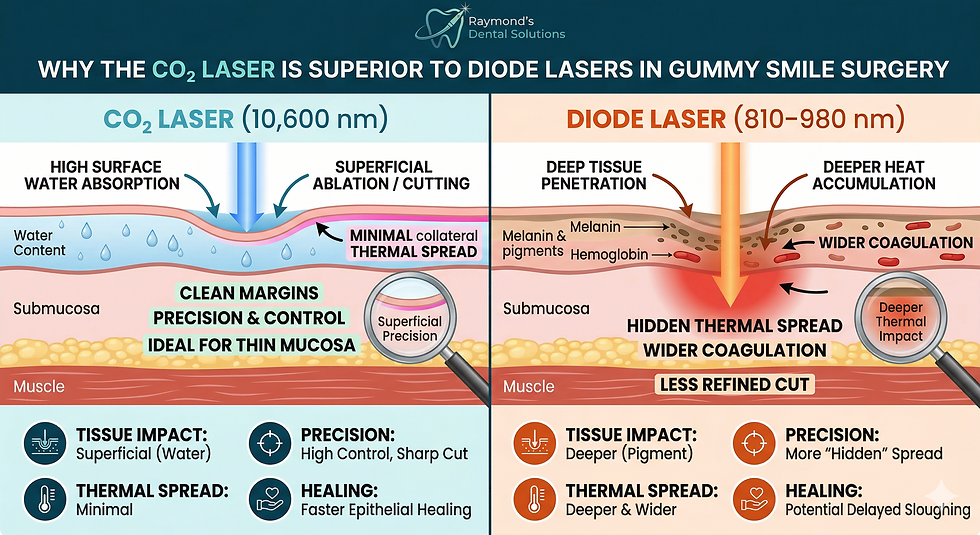
1. The Difference in Tissue Physics
CO₂ lasers and diode lasers behave very differently in soft tissue, and that difference directly affects surgical precision and healing.
CO₂ Laser (10,600 nm): This laser operates at a wavelength where the energy is absorbed almost completely by water at the tissue surface. Since soft tissue contains a very high percentage of water, this allows for extremely superficial cutting, shallow thermal penetration, and minimal collateral heat injury. This is ideal for lip repositioning, where the upper lip mucosa is thin, delicate, and esthetically sensitive.
Diode Laser (810–980 nm): Diode energy is absorbed mainly by melanin, hemoglobin, and pigmented tissue. However, these lasers tend to penetrate deeper into the tissue, leading to more "hidden" thermal spread and less sharp incision margins. In gummy smile surgery, where millimeter-level precision determines success, this deeper thermal spread can become a limitation.
2. Clinical Impact on Lip Repositioning
Lip repositioning surgery requires the surgeon to remove a very precise strip of mucosa. If the cutting depth becomes even slightly excessive, several issues can occur, such as irritation of the muscle layer, increased risk of relapse, or the development of scar tension.
The CO₂ laser offers superior control because the surgeon can remain almost entirely at the mucosal level. This is one major reason why advanced soft-tissue surgeons prefer CO₂ lasers for esthetic vestibular surgery.
3. Bleeding, Pain, and Healing Comparison
Bleeding Control: While both lasers can coagulate, the CO₂ laser provides a particularly clean surgical field because vaporization and coagulation occur simultaneously. A cleaner field means better visibility, allowing the surgeon to perform more symmetrical and precise surgery.
Post-operative Pain: CO₂ lasers often produce less pain because nerve endings are sealed precisely and the inflammatory zone is narrower. With diode lasers, if settings are not perfectly controlled, thermal irritation can spread more widely, especially in sensitive anterior tissue.
Healing Patterns: Clinicians often observe cleaner epithelial healing with CO₂ lasers. Conversely, diode laser surgery may sometimes result in delayed superficial sloughing if excessive heat accumulates. This is why CO₂ lasers often produce more elegant healing results in esthetic surgery.
The Bottom Line
If we summarize the difference in a very simple way:
CO₂ Laser = Microsurgical precision
Diode Laser = A useful soft tissue cutter, but less refined for esthetic vestibular control
Because of these characteristics, the CO₂ laser holds a clear scientific advantage in gummy smile surgery.
If you found this discussion helpful, please consider subscribing to our channel or following our blog. We regularly share clinical insights, research summaries, and practical applications of laser technology in dentistry.
Thank you for reading, and remember—helping you succeed is what drives us.


.png)

Comments